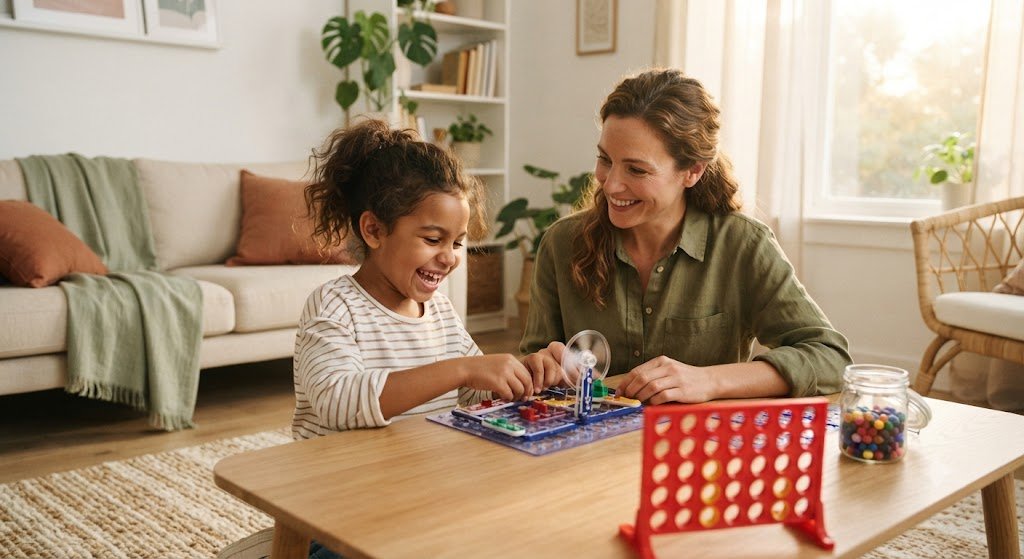
Most gift guides on this site are me reaching back through the memory bank. This one isn’t. My daughter is six right now, so this is the rare list I get to write in the present tense, with the birthday-party circuit, the first-grade friendship dramas, and the “why is the sky blue but the ocean bluer” interrogations all happening live in my kitchen.
And here’s the thing nobody tells you: six is not just a bigger five. Three real shifts happen this year, and they change what makes a gift land. Kids this age can suddenly follow a rule and care, deeply, about whether everyone else follows it too. They can hold a multi-step project in their head without a grown-up narrating every step. And their legs and balance are finally ready for a real bike. Almost every pick below rides one of those three waves. (Still shopping for a preschooler? My gifts for 5-year-olds guide is the younger sibling of this list.)
What six-year-olds are actually working on
Six is the year the wider world moves in. School becomes a daily reality, friendships start to genuinely matter, and independence becomes a point of pride, which tracks exactly with what the CDC describes for early middle childhood: rapid mental growth, more attention to friends and teamwork, and less tolerance for anything that feels babyish. The best gifts at this age treat a kid like the capable person they’re becoming, without quietly requiring an adult to run the show.
How I picked these
Same rules as always. I lean on my own years of watching what actually gets played with versus what migrates to the donation bin, then I pressure-test every pick against a deep pile of real parent reviews and the manufacturers’ own spec sheets, with extra suspicion for any toy that seems designed to impress the gift-giver rather than the kid. Whole categories got cut this round because I couldn’t find a single product I’d name to a friend without hedging. What survived is below.
Quick picks by budget
- Under $10: Connect 4, Taco Cat Goat Cheese Pizza, the bracelet-making kit, rainbow scratch notebooks
- $15–$35: Snap Circuits Beginner, Guess Who?, Rush Hour Junior, the geode kit, the Big Book of Why
- The splurge: a first real pedal bike (plus the helmet, which is not optional)
Real STEM, not toy science
Here’s my gripe with most “STEM toys” for little kids: they’re regular toys wearing a lab coat. What changes at six is that multi-step instructions finally stick, so a kid can genuinely build a thing, watch it work, and understand why. That unlocks the real stuff.
1. Snap Circuits Beginner
Actual working circuits, built by actual six-year-old hands. Pieces snap onto a board like oversized buttons, and suddenly there’s a spinning fan or a glowing light that your kid wired up personally, no soldering, no app, no adult hovering after the first project or two. Watching a kid flip the switch on a circuit they built is watching the exact moment “electricity” stops being an abstract word.
Honest note: this starter set is sized for the 5-to-9 crowd, which is why I picked it, but a kid who tears through it will be lobbying for the bigger Snap Circuits Jr. set within the year. Consider that a feature. Batteries not included, so tuck some in with the gift.
2. National Geographic Break Open Geodes Kit
Ten real geodes, a pair of safety goggles, and permission to smash rocks with a hammer to find the crystals inside. It’s geology, patience, and controlled destruction in one box, which is roughly the six-year-old holy trinity. My daughter’s coat pockets are a permanent gravel collection, so I understand exactly which child this kit was designed for.
Fair warning: this is a driveway-and-adult activity, full stop, and the shards are sharp, so it’s a nap-time project if you have littler ones around. Also, geodes are nature’s loot boxes: most crack open gorgeous, but the occasional dud is part of the deal, and honestly, part of the lesson.
One more STEM lane worth knowing about: screen-free coding robots, the kind a kid programs with buttons and cards instead of a tablet. Six is the sweet spot for the more capable ones, and I went deep on which are genuinely screen-free (and which just pretend to be) in my coding robots guide.
Games with real rules (the fairness year)
Something clicks around six: kids don’t just follow rules, they enforce them, loudly, on everyone at the table. It’s exhausting and it’s also a developmental milestone doing its job. These three games put all that rule-lawyering energy to work.
3. Connect 4
At five, board games are mostly luck. At six, this is the graduation: a game you win by thinking ahead, blocking, and setting little traps. Rounds take five minutes, no reading required, and there’s a genuinely satisfying arc where your kid goes from losing every game to beating you fair and square, and both of you know it was real.
Worth knowing: the current version is lighter-weight plastic than the one you grew up with, and the checkers scatter like startled pigeons when the grid releases. It survives; your feet may not.
4. Guess Who?
Secretly one of the most educational games on this list, disguised as flipping little plastic doors. To win, a kid has to ask questions that eliminate the most options, which is deductive reasoning, category thinking, and first-grade logic homework wearing a mustache. This edition includes a pets deck alongside the people, which keeps it fresh once the classic faces are memorized.
The catch: the flip-frames are flimsier than the vintage version, and a frustrated six-year-old slamming doors shut is their natural predator. A gentle-hands rule extends its life considerably.
5. Taco Cat Goat Cheese Pizza
A word-chant card game that ends in everyone slapping a pile of cards and howling. The box says eight and up, and I’ll be straight with you about why I’m including it anyway: the mechanics are just say-the-word, match-the-picture, slap, and a six-year-old who plays a practice round with a grown-up keeps up fine. What makes it a great gift is the range, because the big cousins and the grandparents genuinely want in, and there aren’t many gifts under ten dollars that can say that.
Fair warning: it is loud, the slapping gets enthusiastic, and losing a close round is an emotional event at six. Which, frankly, is the life skill being practiced.
The first real pedal bike
If there’s one splurge that defines six, it’s this. The balance and leg length are finally there, and a bike is the rare gift that’s also a childhood memory being scheduled in advance. If your kid spent the last couple of years on a balance bike, the transition to pedals is usually startlingly fast, often a single afternoon, because the hard part (balancing) is already solved. (And if you’re here a few years early with a younger sibling, my balance bike guide is where that head start begins.)
6. Schwinn Elm / Koen 16-Inch
Schwinn’s kid line is built on what they call SmartStart geometry: a lighter frame, grips sized for small hands, and pedals set closer together to match kid proportions instead of shrinking down an adult bike. You get a rear coaster brake plus a front hand brake, which is the classic training combo, removable training wheels in the box, a tool-free adjustable seat, and a limited lifetime warranty from a brand that’s been making American kids’ bikes for over a century. Independent bike reviewers consistently land in the same place I did: at this price, it’s the one to beat. The Elm and Koen are the same bike wearing different paint jobs, and colorways drift in and out of stock, so grab whichever one has the right size available and let the kid claim the color.
Honest note: it’s heavier than the boutique kids’ bikes that cost three times as much, and reviewers note the hand brake is more of a training tool than a primary stopper, so kids mostly rely on the coaster brake. Neither changes the verdict at this price. It ships mostly assembled, but budget a real half hour with the instructions.
Make it, wear it, trade it
First grade runs on a barter economy, and the currency is handmade. If you know, you know.
7. A Clay-Bead Bracelet Making Kit
Thousands of flat clay beads in a rainbow of colors, letter beads for names, little charms, and stringing cord: this is the raw material of first-grade diplomacy. Kids this age don’t just make bracelets, they issue them, and a kit like this funds weeks of quiet, focused fine-motor work that happens to double as social capital. It’s also a shockingly good rainy-playdate activity, since one box of beads can occupy a whole table of kids at once.
The catch: these beads are tiny and they will roll, so in a home with a baby or toddler this is a strictly supervised, table-only, count-the-escapees activity. Sort the colors into the compartments once at the start and future-you will be grateful.
8. Rainbow Scratch Notebooks
Black pages, a little wooden stylus, and every line scratched reveals rainbow underneath. Zero markers, zero paint, zero cleanup, which is why scratch pads are the kind of art supply that lives in a mom’s bag rather than the craft cupboard. It has quietly won parenting-industry awards for being exactly what it is: a cheap, mess-free way to buy twenty focused minutes anywhere.
Worth knowing: the scratching sheds a fine black dust, less than glitter by several orders of magnitude, but brush the table after. Scratch pads make the perfect add-on gift when the main present needs a little sidekick.
Quiet, solo, screen-free
After a full school day of being social, some kids need to not be perceived for a while. This one’s for them. (More in this lane in my roundup of screen-free gifts that can compete with a tablet.)
9. ThinkFun Rush Hour Junior
A one-player traffic-jam puzzle: set up the cars per a challenge card, then slide them around until the ice cream truck escapes. Forty challenges ramp from easy wins to genuinely tricky, and the whole thing is compact enough to ride along to restaurants and road trips. What I love most is what it doesn’t need: no opponent, no screen, no parent, just a kid quietly muttering at a plastic bus until the logic clicks.
Honest note: a puzzle-hungry kid will conquer all forty cards eventually, at which point the standard Rush Hour is the natural next rung. Solo by design, so it won’t fill the family-game-night slot; that’s what the games above are for.
For the question machine
10. National Geographic Little Kids First Big Book of Why
Six-year-olds average roughly one thousand questions per car ride, and this book is the pressure valve: real answers to real kid questions, in big photos and language a first grader can follow, from a source you can trust. It’s a browse-together book more than a read-alone one, which is honestly the point, and it has a sneaky second job as a bedtime-stalling negotiation tool that at least stalls productively.
Worth knowing: it’s a chunky hardcover, better for laps and floors than backpacks. If it lands, there’s a whole series (How, Where, Who) waiting behind it, which future gift-givers will thank you for.
A few honest takeaways
If you’re buying one gift, match it to the kid in front of you: the builder gets the circuits, the socialite gets the bracelet kit, the mover gets the bike. If you’re buying for a kid you don’t know well (a classmate party, a friend’s child), the games are the safest money on this list, because rules-and-fairness is the one thing every six-year-old is working on. And if the budget stretches to the bike, do the helmet and the measuring tape at the same time. My husband’s contribution to this guide was pointing out that the bike is really a gift for the parents too, since a kid who can ride is a family that can ride, and I have to admit he’s right.
Want calmer, screen-free afternoons?
The after-school hours are the hardest ones at this age. Grab my free printable list of low-prep, screen-free activities that actually hold a big kid’s attention, sorted by mood and mess level. Pop your email in below and I’ll send it over.
Frequently asked questions
What size bike does a 6-year-old need?
Go by height and inseam, not age. Most six-year-olds who are just learning to pedal fit a 16-inch bike (roughly 38–48 inches tall); taller kids or confident riders may fit an 18- or 20-inch. When in doubt, measure, and don’t size up for growing room, since an oversized bike is harder to control and less safe.
What’s the best gift for a 6-year-old you don’t know well?
A rules-based game like Connect 4 or Taco Cat Goat Cheese Pizza. Every six-year-old is deep in the rules-and-fairness stage, both games work across a wide age range at a family gathering, and neither depends on knowing the kid’s current obsession.
Are STEM toys for 6-year-olds actually worth it?
The hands-on ones are. Six is when multi-step building and cause-and-effect thinking genuinely click, so kits where the kid does the work, like circuits or geodes, earn their keep. Skip anything where a screen or a pre-scripted routine does the thinking for them.
Should I buy different gifts for girls and boys?
I’d shop by interest, not aisle. Everything on this list is a hit with the boys and girls in my daughter’s class alike; the builder/mover/maker/reader split predicts what a kid will love far better than gender does.