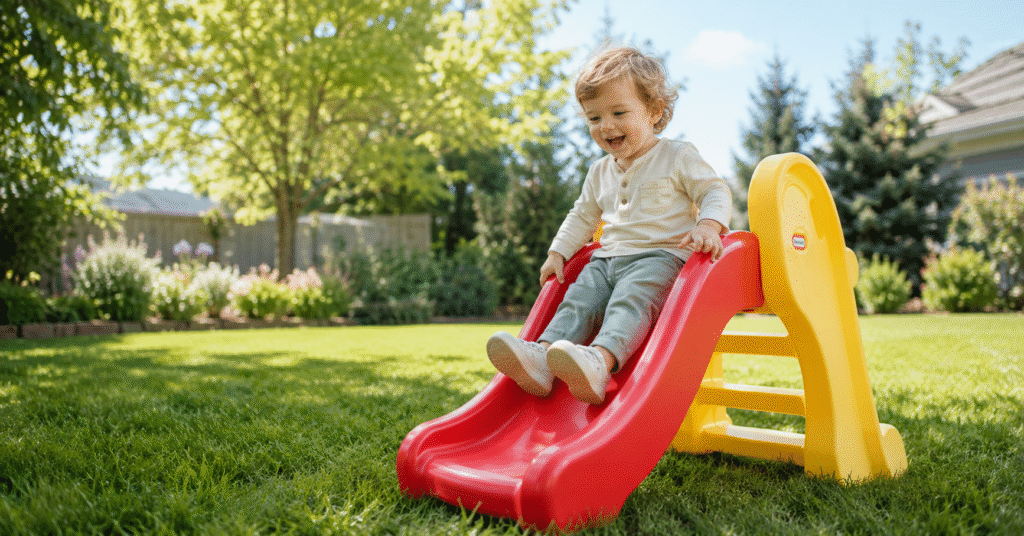
A toddler slide is easy to picture and surprisingly hard to place well. The assembled footprint is only the beginning. You also need the clear use zone around it, protective surfacing under that whole area, and a model whose age, weight, and user limits match the children who will actually climb on it.
The practical answer: if your child still fits a smaller slide and uses it happily, keep it. If you need a larger climbing-and-sliding structure, have room for the full use zone, and want space for more than one child within the stated limits, the Simplay3 Young Explorers Adventure Climber is the only current model that cleared every product and publication check for this update.
This is a deliberately short result. I did not add a weaker product simply to make the list look longer.
Why only one slide remains
The original article compared six products. During this update, several failed current hard gates: some no longer had a clear main Amazon offer, two had independently repeated reports involving a locking or tipping mechanism, and others had unresolved conflicts in age guidance, weight limits, warnings, availability, or exact-product documentation.
I then checked replacement models from established manufacturers. One otherwise promising model displayed an Amazon warning against use by children under 3 while its manufacturer page and instructions stated ages 2–6. Because those sources do not agree, I excluded it rather than interpreting the warning for the reader.
A high average rating does not cancel a repeated structural complaint, and current inventory does not settle a safety or instructions conflict. The result below is the model that passed the same-day identity, documentation, offer, review-pattern, and recall checks. It is a qualified option for a specific setup, not a claim that any slide is risk-free or universally best.
Current research pick for a larger climber
Simplay3 Young Explorers Adventure Climber and Slide
If you have the room and more than one young child, this is the model I would examine first. Its two-level platform, crawl-through space, steering wheel, and slide give children different places to move instead of sending everyone directly back to the ladder.
The model 21813 instructions set the limits above. At 70 inches long and nearly 50 inches high, this is a place-and-leave structure rather than something I would expect to move after every play session.
Critical owner feedback produced two separate checks rather than a repeated mechanism: stay close around the upper openings, and inspect sun-exposed panels for warping along with cracks, loose connections, or other damage. Stop using the structure if a panel changes shape, a connection loosens, or any part no longer fits as the instructions show. Those reports tell us what to inspect; they do not establish how often a problem occurs.
Skip it if: the yard cannot hold the full use zone, you need a fold-away slide, your planned surface does not meet the manual, or any child falls outside the stated age or weight limits.
Checks to do before ordering
Mark the use zone, not only the plastic
Measure the assembled structure, then add the manual’s clearance on every side. Mark that full area on the ground before buying. A climber that technically fits beside a fence, tree, wall, patio edge, or another toy may still fail the required use zone.
Plan protective surfacing as part of the purchase
Grass and bare dirt are not protective surfacing for this installation, and carpeting or an ordinary thin play mat is not enough indoors. Follow the exact model’s fall-height requirement and use properly installed impact-attenuating surfacing appropriate for that height. The CPSC Outdoor Home Playground Safety Handbook explains surface materials, depth, containment, and maintenance.
Use the exact instructions
Similar-looking products from the same brand can have different limits. Keep the model information and instructions, follow the assembly sequence, and confirm that every step, brace, handle, and fastener is fully seated. Do not improvise a missing part or use the climber while a connection is loose.
Check the structure before each session
Look for loose fasteners, cracks, warping, sharp damage, movement at the base, and hot plastic. Clear toys and people from the slide exit. Keep cords, necklaces, drawstrings, and helmets away from the equipment, and follow the manual’s limits for wet conditions and cold weather.
Safety rules that apply every time
- Stay close during active play. Supervision helps manage crowding, climbing on the slide surface, and a blocked exit, but it does not replace correct assembly, level placement, adequate clearance, or protective surfacing.
- Follow every product limit together. Age guidance does not override weight or user limits, and a multi-user rating does not mean several children should crowd the slide path.
- Use the slide seated and feet first. Keep the exit clear. Do not ride down with a child on an adult’s lap; HealthyChildren’s playground guidance explains the leg-injury risk.
- Stop when anything changes. Remove the equipment from use if a component bends, warps, cracks, loosens, rocks, or fails to lock as the instructions require.
Recall check
On October 6, 2026, I searched the CPSC Recalls and Product Safety Warnings records using Simplay3, the exact product name, UPC 852806007864, and model-family identifiers 21813, 21813R-01, and 218130-02. I did not find a notice I could attribute to this exact model. That dated search is not a guarantee about future notices. Check the current CPSC records and the manufacturer’s instructions before purchase and again when bringing stored equipment back into use.
Frequently asked questions
What age is right for this toddler slide?
The Simplay3 instructions state over 18 months through 6 years for model 21813. Age alone is not enough: each child must also be within the 60-pound limit and able to follow the play rules. Up to three children may use the structure within those limits, while the slide path and landing area still need to stay clear.
Can the climber sit directly on grass?
No. Its instructions include grass among the surfaces that should not sit directly below the equipment. Plan protective surfacing for the stated 50-inch fall height and the full use zone.
Can it be used indoors?
The instructions allow indoor and outdoor domestic use, but the same clearance and protective-surfacing requirements still apply indoors. Carpet and an ordinary thin mat do not satisfy that requirement.
Can siblings play together?
The manual allows up to three children, each no more than 60 pounds and within the stated age range. An adult should still prevent crowding at the platform, slide, and exit.
How often should I inspect a plastic slide?
Do a quick check before every session and follow the manual’s maintenance schedule. Inspect connections, fasteners, steps, panels, and the base; check for heat, cracks, warping, or movement; and stop use when something is damaged or no longer fits correctly.
If the current slide still fits, there is no need to replace it on a schedule. If you are ready to move up, mark the footprint and full clearance first, price the required surface, and read the exact instructions before the box arrives. The useful choice is the one that fits the whole play area and every child who will use it.