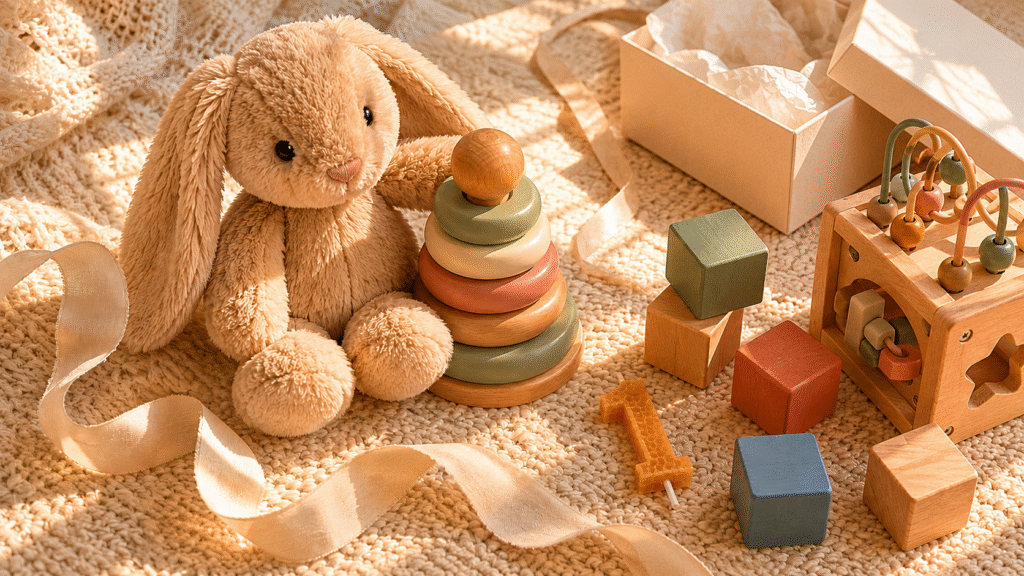
Most of us have stood in the toy aisle the week before someone’s first birthday and thought the same thing: the baby isn’t going to remember this, but somehow it still needs to be good. The parents will remember the gift forever, because half of the things you buy a one-year-old will become living-room fixtures for the next two years. So the real question isn’t “what does a one-year-old like” (the answer is “anything that crinkles, anything with wheels, and your phone”). It’s what’s still in steady rotation eight months later, and what makes the parents’ lives easier or more fun in the meantime.
I’ve put three kids through the 12-to-18-month window now. After watching what got daily play, what got shoved under the couch, and what other parents kept asking me about at playdates, this is the shortlist I send to friends, aunts, and grandparents who text me before the party. Every gift here works for both boys and girls, fits a wide budget range, and earns its space in a small apartment. This is the 2026 version of the list — a few classic picks haven’t changed in a decade, and a couple of newer ones have earned their spot.
How I Chose These (and What I Left Out)
Three things I check before anything else. First, the toy has to actually be used by a one-year-old, not by a precocious 18-month-old “with adult help.” Boxes that say Ages 2+ are out, no matter how pretty the wooden chunky puzzle is. Second, it has to survive being chewed, banged on the floor, and dropped into a yogurt cup. Third, it has to do something the baby hasn’t seen yet at home, so the gift feels like a gift rather than an extra version of something already in the toy basket.
For the developmental side I leaned on the American Academy of Pediatrics’ framing of play as the foundation for early learning. Their guidance on choosing toys for this age points to open-ended toys, things that encourage movement, and toys that pull caregivers into the play (the AAP’s toy buying tips for babies and young children are a useful starting point). What that means in practice: stacking, sorting, pushing, pulling, music, and one stuffed friend the kid bonds with. Almost every pick below falls into one of those buckets.
1. VTech Sit-to-Stand Learning Walker — The Crowd-Pleaser
If a registry has exactly one push-walker on it, it’s almost always this one. The VTech Sit-to-Stand has been the default first-birthday gift in American suburbs for over a decade, and there’s a reason it keeps showing up at the top of registries. The front panel detaches for floor play in the months before walking, then snaps back on when the baby is pulling up and ready to push something across the room.
The panel itself is genuinely good. Spinning gears, a little phone handset, light-up shape buttons, five piano keys, and a few rollers — enough variety that a 10-month-old finds something interesting and a 16-month-old still hasn’t mastered all of it. My daughter wore the orange version out, and by the time it was passed down to my youngest, the only sign of age was a slightly sticky phone receiver from a yogurt incident no one wants to revisit.
Check Price on Amazon →
2. Fisher-Price Little People Big Yellow School Bus — Pretend Play Starter
Most one-year-olds aren’t doing real pretend play yet. They’re doing the precursor: putting things into things, taking them out, lining them up, and dumping them. The Little People school bus is engineered exactly for that stage. The roof opens, the door opens, the figures fit through the windows, and there are nine of them, so something is always within reach when the others have rolled under the couch.
The Community Heroes version comes with a teacher, firefighter, mail worker, medical professional, and a small ensemble of other neighborhood figures. The bus also has a wheelchair ramp on the side, which I appreciated more than I expected to. It became a separate little game on its own. The pull handle locks upright for stability, and the bus plays a handful of cheerful little tunes that, fair warning, you will hum in the shower.
Check Price on Amazon →
3. MEGA BLOKS Build ‘n Play Bag — The Sleeper Hit
For under twenty dollars this is the toy I’m most confident will get the most playtime per dollar. Sixty oversized building blocks, all sized for hands that still struggle with a Cheerio, and (this is the recent upgrade) made from a plant-based plastic derived from at least 90% sugarcane ethanol. They snap together easier than Duplo (which the same kid will graduate to in about six months), and the whole set zips into a reusable bag that doubles as cleanup motivation. The packaging itself is 100% recyclable.
The bag matters more than people expect. Once you’ve stepped on a stray block in bare feet at 11 p.m. you understand why every parent eventually develops strong feelings about toy storage. The included bag with the hand-strap means the blocks live in one place, can be hauled to the grandparents’ house, and don’t require a whole separate bin from Target.
If the recipient already has Mega Bloks, this set still integrates. It’s compatible with everything in the line, so duplicates aren’t really duplicates. They’re more pieces to build a taller tower with.
Check Price on Amazon →
4. Toyventive Wooden Activity Cube — The All-in-One
Activity cubes are a category where almost everyone makes one, and most of them are fine. This one is the standout because of how it’s packaged. The cube itself is a wooden block with several play sides: a bead maze on top, a shape sorter on one face, a color-matching panel, a counting abacus, and a gear panel. Inside the box you also get a small set of stacking cups, a board book, and a play-ideas guide for the adult who is going to be sitting on the floor with the kid.
That gift-set framing is the difference. Instead of a single toy, the recipient unwraps four small things, which is more fun for a one-year-old (more boxes, more crinkly paper, more reveals). It also means whoever is gifting it doesn’t have to add a “small extra.” The whole thing comes in either a blue or pink presentation box, with the cube itself being identical inside. The marketing splits boys and girls, but the actual toy doesn’t.
Blue (Boys) → Pink (Girls) →
5. Radio Flyer Walker Wagon with Garden Tools — Built for the Driveway
Of the two walker-style gifts on this list, this is the one you want if the family has any kind of outdoor space, even just a driveway, a sidewalk, or a small patch of grass. The handle locks upright so it works as a stable push walker for a kid who’s still working on balance, then unlocks into a regular pull wagon when they’re confident on their feet. The little garden tools tucked inside (a rake, a shovel, a watering can; exact pieces vary by year) turn the wagon into a pretend gardening setup the minute they can sit down.
Radio Flyer has been making variations of the red wagon since 1917, and the build quality reflects that. The wheels are solid, the bucket has actual storage room (not the symbolic kind on some toy wagons), and the maximum weight is 35 pounds, which covers most kids well past their second birthday.
One honest note: the body on this version is plastic, not the classic wood you might be picturing. If a wooden Radio Flyer is non-negotiable, the brand makes a Classic Walker Wagon at roughly double the price. For most one-year-olds the plastic is the more practical choice. It’s lighter for them to push and easier to wipe down after a muddy afternoon.
Check Price on Amazon →
6. Baby Einstein & Hape Magic Touch Piano — The “Real Toy” That Looks Good in the Living Room
The Magic Touch Piano is the one toy in our house I never had to apologize for leaving out when guests came over. It’s a small wooden piano, painted with eleven flat color-coded keys, and instead of plastic buttons it uses touch sensors hidden under the wood. A baby pressing the surface with a flat palm gets a real piano note. A toddler tapping with one finger gets the same. There’s nothing to break, no keys to pry off, no batteries leaking after a year on the shelf (though it does take three AAs that aren’t included in the box).
The piano comes with three thin sheet-music cards. The notes on the card are color-coded to match the colors on the piano, so a one-year-old can “play” Twinkle Twinkle by matching color to color long before they understand what a song actually is. My older son figured this out around 18 months and still pulls the piano out occasionally at three.
It’s the Hape build quality, which means smooth-sanded edges, real wood, and a finish that doesn’t gum up after a year in a humid bathroom-adjacent playroom.
Check Price on Amazon →
7. Fisher-Price Rock-a-Stack — The Classic That Still Earns Its Spot
Some toys are on every list because they actually work, and the ring stacker is one of them. Five colored rings, a rocking base that won’t fall over when whacked, and a smallest ring with a mirror surface that babies stare at like it’s a tiny TV. There’s nothing flashy here, which is the point. At twelve months a kid is figuring out that big rings won’t fit inside small ones, and the stacker is essentially a tactile lecture on that idea, with the kid figuring it out one ring at a time. If you’re stocking up on this whole category, our best stacking and nesting toys guide covers seven more options at different price points.
The newer plant-based version uses a material made from at least 90% ethanol extracted from sugar cane, and ships in FSC-certified packaging. The toy feels and functions identically to the original ABS plastic version (I have both, three kids’ worth of hand-me-downs), and if the family you’re gifting is sustainability-conscious, this is a small choice that lands well.
Check Price on Amazon →
8. Melissa & Doug Match & Roll Shape Sorter — The One That Stays Hard Enough
Most shape sorters give a one-year-old a circle, a triangle, and a square. This one ups the ante: parallelogram, quatrefoil, pentagon, and a couple of other shapes you probably haven’t named since geometry class. That sounds like a gimmick, but it isn’t. The harder shapes mean the toy stays interesting for an extra six to nine months, instead of getting solved in two weeks and abandoned.
The drum-shaped wooden body rolls, which lets a younger one-year-old enjoy it as a push toy before they’re ready to actually sort. The lid pops on and off to retrieve dropped pieces, and the colors are matched to the holes, so the puzzle becomes “match the shape and match the color” once the kid is ready. Melissa & Doug’s wood is the standard you’d expect: sanded smooth, paint that doesn’t chip in week one, and the kind of weight that says the toy will probably outlast the recipient’s whole toddler era.
Check Price on Amazon →
9. Munchkin Float & Play Bubbles — The Bath-Time Add-On
This is the gift that goes with the gift. Under ten dollars, useful from four months onward, and solves the one universal complaint about bath toys: the mold problem. The classic squeezy rubber duck draws water in through a hole and then never really dries, and after six months of nightly baths you’re holding a science experiment. Munchkin’s Float & Play bubbles are sealed shut. No hole, no water inside, no mold. That alone earns them a place in the gift bag.
What’s inside each bubble does the actual playing. One has a rattle, one has a spinner, one bobbles, and one catches light and shines. You get four of them, sized for hands too small to grip a normal bath toy. They float, they bob, they roll across a wet floor. They also work outside the tub on a beach day or at the splash pad.
If the bigger gift is the school bus or the walker, this is the thing you slip in alongside it so the parents have something to hand the baby that night in the bath.
Check Price on Amazon →
10. Jellycat Bashful Beige Bunny — The One They’ll Keep Forever
If you’re picking only one gift on this list and you want it to still be in the kid’s bed at age eight, this is the one. Jellycat plush is a different category from the soft toys you grab at Target. The fur is velvet-soft in a way that doesn’t compress flat after the first wash, the construction is multi-layered so the limbs hold their shape, and the bashful sitting posture (head tilted, ears flopped forward) is engineered to look slightly sad and lovable, which is exactly the look that makes a one-year-old pick it up and decide it’s theirs.
The medium Bashful Bunny is twelve inches tall, which is the size sweet spot. Big enough to hug, small enough to fit in a car seat without taking up the second cup-holder. Beige is the classic neutral, and the bunny comes in roughly a dozen colors if you want something that matches a nursery (cream, grey, tulip pink, blush, woodland brown, viola purple). Care is surface-clean only, so a small note for the parents: this is a “wipe with a damp cloth, don’t put it in the washing machine” friend.
It’s the most expensive gift on this list, and worth every dollar if you want the kind of present that gets in every family photo for the next decade.
Check Price on Amazon →
What Actually Makes a Good 1st Birthday Gift
If you’re shopping outside this list, four things matter more than the brand on the box.
Age grading. The number on the box exists for safety, not marketing. A “2+” toy aimed at a 12-month-old usually has small parts that can fit through the standard CPSC choke-test cylinder, which means it can choke a one-year-old. This is the one filter I don’t bend, no matter how beautiful the wooden puzzle is. There will be plenty of time for that toy at the next birthday.
Open-endedness. Toys that do one thing get solved fast. A walker is technically a one-trick toy, but the play around it (loading it with stuffed animals, pushing it to the kitchen, parking it under the table) is open-ended. Building blocks, ring stackers, and pretend-play sets all share this quality. Toys with one button and one song get old by month three.
Whether parents want to play it too. A one-year-old plays with toys for about ten minutes at a stretch. The rest of the time, they’re playing with you, using the toy as the prop. Anything that bores the adult into checking their phone is going to get less playtime than the toy you sit down to with them. The Magic Touch Piano on this list is here partly because adults enjoy poking out melodies with their kid.
Where it’s going to live. One-year-old toys are large and unsubtle. If the family is in a small apartment, the school bus is glorious but takes up real shelf space. The Match & Roll Shape Sorter and the Float & Play Bubbles both store small. It’s worth thinking about before adding the third giant push-toy to a small living room.
Frequently Asked Questions
How many gifts is the right number for a first birthday?
For the actual birthday from immediate family, one to three is plenty. The kid can’t focus on more, and unwrapping itself is the entertainment. If the party has a bigger guest list, consider asking guests to contribute to a single larger gift (the walker or the school bus) rather than each bringing their own. Most parents I know would rather have one great toy than five mediocre ones to find storage for.
What if the baby is closer to 10 or 11 months?
Everything on this list works for that window with one caveat: the Match & Roll Shape Sorter and the Little People bus are marketed as 12+ months because of small-part safety. For under-12-months, the Rock-a-Stack, the VTech Walker, the Float & Play Bubbles, the Magic Touch Piano, and the Jellycat bunny are all rated 6+ and totally appropriate.
Are any of these daycare-friendly?
If you want something that can be labeled and tossed in a daycare bag, the Float & Play Bubbles, the Rock-a-Stack, and a small Jellycat (the bunny also comes in a 7-inch “small” size) travel well. The walkers, the bus, and the activity cube are home toys. They’re too big for a daycare cubby and too sensitive to other kids’ bumps and chews to hold up to a full day in a shared classroom.
Are books okay as a 1st birthday gift?
Yes, with a caveat. Board books read aloud are the single best thing you can do for early language at this age, but a stack of books doesn’t have much unwrap-day excitement compared to a walker or a piano. The way I’d handle it: pair a small board-book set with one of the active toys above (our best books for 1 year olds lists eight classics worth pairing with anything here). The book lasts longer than the toy in the long run, and the toy makes the party photos.
What about clothes?
Skip clothes from people who aren’t immediate family. Sizing is unpredictable at this age, the kid grows out of every wardrobe in about six weeks, and clothes are the gift least likely to actually get used. The exception is a personalized something (an embroidered jacket, a name blanket) that becomes a keepsake regardless of fit.
Battery toys versus no-battery: does it matter?
Less than the internet implies. A one-year-old benefits from both. Battery toys teach cause-and-effect quickly (push button, get song), and quiet wooden toys leave more room for the child’s own sound effects and conversation. The mix on this list is roughly half and half, which mirrors the play environment I’d actually set up at home.
Prices on Amazon move around, so worth a quick glance at checkout to confirm what you’re actually paying. If a pick is out of stock, the brand’s other color variants usually have the same product underneath.