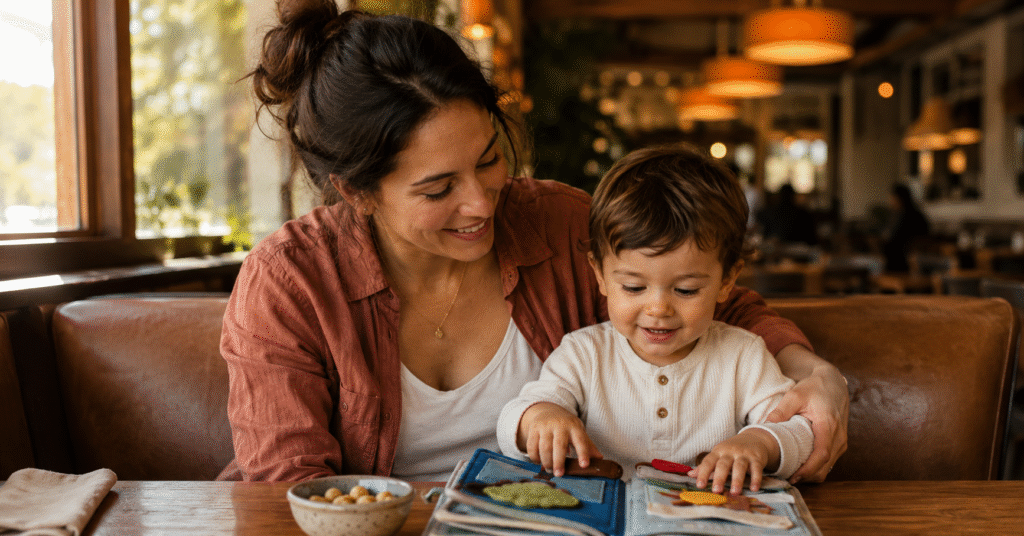
The last time all five of us went out for dinner, my youngest son discovered that a spoon, when dropped from high chair height, makes three completely different sounds depending on what it lands on. He ran the experiment eleven times. My older son spent the same twenty minutes negotiating the terms under which he would remain seated, and my daughter, who is six and considers herself above all of this, just sighed like a tiny disappointed manager.
We still go out. That’s the whole point of this post. Eating at restaurants with a toddler is a skill your family builds, not a punishment you endure, and after years of doing it with three kids I can tell you the difference between a disaster dinner and a pretty good one usually comes down to what’s in your bag and what you do in the first ten minutes. So here’s the system: what to pack, when to deploy it, and the one thing nobody tells you about quitting while you’re ahead.
Before You Leave: The Five-Minute Pack Check
Half of restaurant survival happens before you put your shoes on.
Go early. Embarrassingly early. The 5pm dinner crowd is toddlers and retirees, and both groups understand each other on a spiritual level. The American Academy of Pediatrics makes the same point in its guide to eating out with young kids: beat the rush and you get faster service, a less tired child, and neighboring tables full of families running the exact same play. Ask for a booth if there is one. A booth gives your kiddo a wall on one side and a parent on the other, which cuts the escape routes in half.
Then the bag. Mine lives by the door and gets a five-minute check before we leave, because a busy bag with a missing water pen is just a sad zipper pouch. The full kit, which we’ll walk through piece by piece:
- A seat solution (because the restaurant high chair is a lottery)
- A clean eating surface (pick your camp: disposable or silicone)
- A bowl that fights back when thrown
- Two quiet activities, not five
- Wipes. Always more wipes than you think.
The First Ten Minutes: Claiming Your Territory
You sit down. The clock starts. Whatever you set up in these first minutes determines whether you get to eat your own food warm.
The high chair lottery, and how to stop playing it
Every parent knows the restaurant high chair gamble. Sometimes you get a clean, sturdy one. Sometimes you get the wobbly veteran with a strap that was chewed off during the Obama administration. And sometimes the host just looks at you apologetically and offers a stack of menus to sit on.
This is why hook-on chairs have such a devoted following among parents who eat out a lot. They’re compact seats that clamp directly onto the table edge, so your child sits with the family instead of bobbing in a separate plastic island. They’re also, and this genuinely surprised me when I went down the research rabbit hole, one of the more tightly regulated baby gear categories in the United States: hook-on chairs sold here must meet a mandatory federal safety standard that was just updated again in early 2026. That doesn’t make every model equal, but it does mean the category itself has been stress-tested in ways a lot of baby products haven’t.
The one that comes up constantly, in parent forums, in travel groups, in roughly every “what do you actually use” thread I’ve read, is the Inglesina Fast Table Chair. It’s been around long enough that some of the parents recommending it now sat in one themselves. The pattern in reviews is remarkably consistent: it twists onto the table in under a minute, folds nearly flat, hides its own carry bag under the seat, and the cover goes in the washing machine after the inevitable yogurt incident. It’s the expensive option in the category, and reviewers don’t pretend otherwise; what they say is that it outlasts the toddler years and then gets handed down.
If the price makes you wince, the budget end of the category has matured a lot. The lulunemo hook-on chair shows up again and again in “is the cheap one fine?” discussions, and the consensus from well over a thousand reviews is: for occasional restaurant use, yes. You give up some polish and the brand pedigree, and you keep most of the function and about half your money.
The placemat question: pick your camp
Restaurant tables get wiped, not washed. If your little one is at the stage where the table is the plate, you want your own surface between their snack and whatever the rag spread around an hour ago.
There are two camps here, and I have been both moms at different stages. Camp one is disposable stick-on mats: peel, press, and at the end of the meal you ball up the evidence and walk away. The Babebay stick-on placemats are the bestseller in this lane for a reason, with adhesive edges that actually hold when a determined one-year-old tries to peel up the corner mid-meal. The trade-off is obvious: you’re buying them forever, and you’re throwing plastic away every time.
Camp two is one good silicone mat you rinse and reuse. The Table Tyke placemat has the cleverest design I’ve seen in this category: a bumper that wraps over the table edge, so a teething kiddo gnawing the side of the table (they all do it, don’t let anyone tell you otherwise) is gnawing food-grade silicone instead of mystery laminate. It rolls up with its own little loops and doubles as a craft mat at home. The trade-off is mirror-opposite of camp one: it costs more upfront, covers less table, and rides home dirty in your bag.
Toss-it moms, rinse-it moms, you’re both right. The only wrong move is trusting the table.
The Waiting Game: A Busy Bag That Buys You Twenty Minutes
The math nobody does out loud: from sitting down to food arriving is usually twenty to thirty minutes, which is roughly four toddler attention spans laid end to end. The busy bag exists to bridge that gap, and the difference between one that works and one that doesn’t comes down to three rules I learned the hard way:
- Silent or it stays home. The restaurant version of any toy is the version without batteries.
- Small footprint. You get maybe the space of a placemat to work with. Anything that rolls will roll under the table of the couple celebrating their anniversary.
- Rotation beats quantity. A toy that lives in the restaurant bag and never appears at home stays interesting for months. The same toy left in the living room dies in a week.
For the one-to-three crowd, fabric busy books are the workhorse. My youngest son is deep in the buckle-and-velcro stage, the developmental window where unzipping something is the most satisfying activity on earth, and this is exactly what these books are built for. The hahaland farm busy book is the one I’d point a friend to after comparing the options in this category: every activity is sewn in rather than loose, which matters enormously at a restaurant because nothing detaches, hits the floor, and triggers the under-table rescue crawl. Parents in reviews consistently mention the restaurant and airplane use case specifically, which tells you who’s actually buying it.
For the three-and-up crowd, there is one answer so universal it’s practically a password among American parents: Water Wow pads from Melissa & Doug. A fat water pen, pages that bloom into color when wet and fade blank as they dry, zero mess, infinitely reusable. My older son is in the target age band for these, and the search-and-find game printed on each page is pitched exactly at a kid that age who wants a mission, not just coloring. One honest note from the review pattern: a freshly painted page takes a few minutes to dry before it can be redone, so one pad can hit a lull mid-meal. The veteran move is carrying two and swapping.
And you don’t have to buy your whole bag. Some of the best restaurant entertainment is free: a strip of painter’s tape stuck along the table edge for peeling, a sheet of dollar-store stickers, the sugar packet caddy (sorting by color is a legitimate activity, the restaurant can cope), or the loyalty cards in your wallet, which for some reason are more fascinating than any toy ever manufactured. Two bought items plus two improvised ones is a complete arsenal.
When the Food Arrives: Damage Control
Food on the table changes the game from boredom management to gravity management.
A suction bowl is the single cheapest upgrade to your odds. The Munchkin Stay Put bowls are the ones your own mother would recognize; they’ve been the default first suction bowl for so long that they’re practically generational. Three nesting sizes, a quick-release tab so an adult can pop them off without a wrestling match, and a suction base strong enough to survive a one-year-old’s best two-handed pull.
Now the honest part, because this is where suction bowls get oversold: suction needs a smooth surface. On laminate, sealed wood, or a tray, these grip like they’re welded down. On the rustic raw-wood table at the farmhouse-style place, or anything with deep grain or texture, the seal won’t hold and the bowl becomes just a bowl. That isn’t a defect of one brand, it’s physics, and the review sections of every suction product on the market tell the same story. Plan accordingly: the bowl is your first line of defense, not a guarantee, and your forearm remains the goalkeeper.
Two tactical notes for this phase, both of which echo the AAP’s restaurant advice: order your child’s food with the appetizers so it lands before the meltdown window, and the moment you’re seated, sweep the danger zone, pushing knives, glassware, and the adorable little oil-and-vinegar set out of arm’s reach. Restaurants are not childproofed, and the out-of-sight principle works better than any amount of “please don’t touch that.”
The Exit Strategy: Knowing When to Fold
No gear in this section. Just the rule that took me three children to learn: leave on a high note, not at the bitter end.
A toddler has a finite number of good restaurant minutes, and you can feel when they’re running out. The rookie mistake is pushing through to dessert because the evening was going so well. The veteran move is treating “going well” as the signal to wrap up. Ask for the check when the entrées land, not after. If you’re dining with your partner, agree on a tag-out signal beforehand so one of you can do a parking-lot lap with the wiggly one while the other handles boxes and the bill. And if you’re flying solo with the kids, like I am more often than not, lower the bar further and feel zero shame: a forty-minute dinner where everyone leaves smiling is a triumph. A ninety-minute dinner that ends in a hallway meltdown teaches your child that restaurants are where bad things happen.
Short, frequent, low-stakes outings are how kids learn to be people in public. The goal isn’t one perfect dinner. It’s a kid who, by kindergarten, sighs at her younger brothers like a tiny disappointed manager because she’s been doing this her whole life.
What I Skip (and You Can Too)
The internet will try to sell you an entire second diaper bag of restaurant gear. Here’s what doesn’t make the cut in our house:
- Anything with sound. Even “soft” electronic toys are loud in a quiet dining room. If it has a speaker, it stays home.
- Magnetic tile sets and other heavy crowd-pleasers. Wonderful toys, terrible travel companions. Heavy, clattery, and the pieces have a homing instinct for the floor.
- Play dough at the table. I know, it’s quiet. It’s also a thousand crumbs ground into a carpet someone else vacuums. Restaurant staff are people.
- The tablet as the default. Not a judgment, every parent has a break-glass screen moment, but if the screen comes out at minute one, your child never gets the chance to practice being bored and surviving it. Save it for the true emergency.
- A full bib wardrobe. One bib. The shirt is going in the wash anyway.
If you’re building out the rest of your eating-out toolkit, the next logical reads are our guide to feeding gear that actually earns its drawer space and our breakdown of screen-free activities that work outside the house.
Now go book the early table. The retirees are saving you a seat.