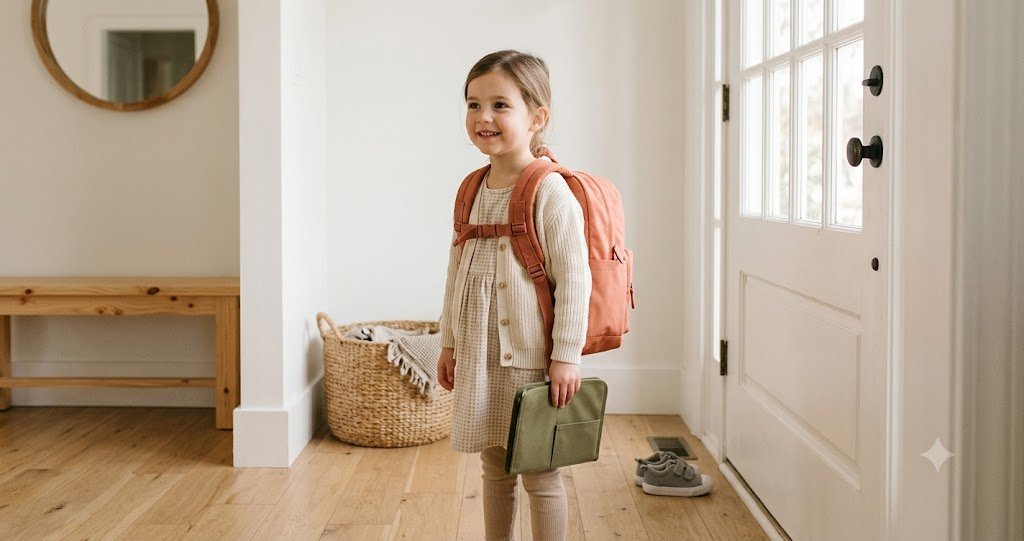
When my daughter started kindergarten last fall, I made a mistake that I now know is basically a rite of passage: I sent her on day one with her old preschool backpack. It was adorable. It was also twelve inches tall, and by day three it was clearly losing a fight with her take-home folder, which came back to me bent into a sad little taco every single afternoon.
The folder. Nobody warns you about the folder.
Kindergarten is the year backpacks stop being a cute accessory and start being actual equipment. There’s a daily folder, a lunch box, a water bottle, a spare change of clothes for the first few months, and every so often a library book the size of a placemat. So when I finally sat down to research a replacement, I went about it the way I do everything for this blog: pulled up the measurements, read the unhappy reviews first, and figured out what actually fits a five-year-old body. Here’s everything I learned, including the size chart I wish someone had handed me in August.
Quick Picks: The Short Version
| Pick | Best for | Height of pack | Typical price |
|---|---|---|---|
| Simple Modern Fletcher (Medium) | Best overall for kindergarten | 15″ | around $35–$45 |
| mommore 3-Piece Set | Best all-in-one set (lunch bag included) | 15.7″ | around $25–$30 |
| Wildkin 15 Inch | Most durable / classic choice | 15″ | around $25–$30 |
| BrainyBees 15″ | Best budget pick with a snack pocket | 15″ | around $18–$22 |
| atgark 13″ | Petite kindergartners & young fives | 13″ | around $18–$22 |
If you just want the one-sentence answer: for almost every kindergartner, you want a backpack that’s about 15 inches tall. Below is why, plus how to check the fit on your actual kid instead of guessing.
The Fit Guide: What Size Backpack by Height
Kids’ backpacks are sized by the height of the bag itself, usually 12, 13, 15, or 16-plus inches. Most 5- and 6-year-olds land somewhere between 41 and 48 inches tall, and that range maps onto backpack sizes pretty cleanly:
| Your child’s height | Backpack size | Notes |
|---|---|---|
| Under about 42″ | 13″ | For petite kindergartners and kids who just turned five. Check that it fits a standard folder before buying. |
| About 42–48″ | 15″ | The kindergarten sweet spot. Fits the folder, the lunch box, and the library book without swallowing the child. |
| Over 48″ | 15″ (still!) | Tall kindergartners don’t need a bigger bag, because the stuff they carry is the same. Save the 16–17″ packs for the binder years. |
Notice that the answer is 15 inches almost across the board. The height chart matters most at the edges: a tiny just-turned-five kid can genuinely drown in a 15-inch pack, and a tall six-year-old does not need the teen-sized bag her big cousin carries, no matter how convincingly she argues otherwise.
The Three-Point Fit Check
Whatever you buy, put it on your child with a little weight inside (a couple of books works) and check three things:
- The bottom of the pack should sit at the waist, not sag down over their bottom. A bag that hangs low pulls the shoulders back and turns your kiddo into a small, tired turtle.
- The pack should be no wider than their torso. If it sticks out past their sides, it’s too big, full stop.
- Straps snug, and both of them worn. Padded straps adjusted so the pack sits against the back, not swinging away from it. The one-shoulder look can wait until middle school.
The weight rule: the American Academy of Pediatrics says a loaded backpack shouldn’t weigh more than 15% of a child’s body weight, and many experts (including Nemours KidsHealth) suggest staying closer to 10% when you can. For a typical 40–45 pound kindergartner, that works out to roughly 4–6 pounds total, which is one more reason not to buy a giant bag: empty space gets filled. Usually with rocks.
The Folder Test
Here’s the single most useful thing in this whole article. Before you buy any kindergarten backpack, check whether it fits a standard two-pocket folder, which measures roughly 9.5 by 11.75 inches. That folder goes home every day in most American kindergarten classrooms, and it’s the reason 12-inch preschool backpacks flunk out of kindergarten: the folder physically does not fit, so it comes home folded, crumpled, or creatively wedged.
Every 15-inch pack on this list passes the folder test. The 13-inch pick passes it snugly. Anything shorter than 13 inches doesn’t, and no amount of cuteness fixes that.
The Best Kindergarten Backpacks
A quick note on how I choose products: I research these the way I’d research for my own kids, starting with the specs and the critical reviews rather than the marketing copy. Every pick below cleared my usual bar for ratings, review history, and availability before it made the list.
1. Simple Modern Fletcher Kids’ Backpack, Medium — Best Overall
The Fletcher shows up on kindergarten packing lists and mom group threads over and over, and once you look at the details it’s easy to see why. It’s exactly folder-sized, it has a padded interior sleeve that works for a tablet or a flat folder, two stretchy side pockets that actually hold a real kid-sized water bottle, and a chest strap, which is the unsung hero feature for five-year-olds whose shoulders are still basically slopes.
Two honest caveats from my research. First, a slice of reviewers find it smaller than they expected; it’s a kindergarten bag, not an elementary bag, and if you go in knowing that, the size is a feature rather than a flaw. Second, it’s wipe-clean only, so if you’re a throw-it-in-the-washer family, look at the Wildkin below instead. The brand backs it with a limited lifetime warranty on defects, and the same bag comes in a big range of prints, including licensed Disney and character versions if your child has, say, extremely firm opinions about princesses. Those usually run higher than the standard patterns.
2. mommore Kids Backpack 3-Piece Set — Best All-in-One Set
If the phrase “and now I have to go buy a matching lunch box” makes you tired, this is the pick. The set bundles a folder-sized backpack with an insulated lunch bag and a little pencil case, all in the same print, for less than many standalone backpacks. The whole set weighs about as much as a hardcover book, and there’s a chest strap here too.
The trade-off with any bundle is that no single piece is best-in-class. The lunch bag is a basic soft-sided insulated bag; it’ll keep an ice pack cold through lunchtime, but it’s not a Bentgo-level system, and if your child is a hot-lunch-in-a-thermos kid you’ll still want a proper container inside it. As a get-ready-for-kindergarten kit for the price, though, it’s genuinely hard to beat, and it’s the one I’d grab for a family outfitting more than one kid at once. Ask me how I know that math.
3. Wildkin 15 Inch Backpack — Most Durable Classic
Wildkin has been making this exact style of kids’ backpack since before today’s kindergartners were born, and it’s the closest thing on this list to the sturdy bags we carried as kids ourselves. The fabric is thick 600-denier polyester, the zippers are chunky, and at 7 inches deep it’s noticeably roomier than the slimmer packs here, with two separate zip compartments and a real pencil organizer inside. The brand is a Nashville-based small business, and every print coordinates with matching Wildkin lunch boxes and water bottles if your child is the type who wants the full matching set.
What it doesn’t have is a chest strap, which is my one hesitation for the smallest kindergartners; on a solid-shouldered six-year-old it’s a non-issue. Reviewers with older kids regularly mention these lasting multiple school years, which makes the price feel almost quaint.
4. BrainyBees 15″ Kids Backpack — Best Budget Pick
This one earns its spot with a clever front pocket: it’s lined with wipeable, food-safe PEVA, so it works as a built-in snack compartment that keeps a squished juice box or a sweaty cheese stick from ever touching the homework. The lining is designed to contain drips so they wipe out in seconds instead of soaking into the fabric. Add S-shaped padded straps, a chest strap, reflective strips on all four sides, and a water-resistant shell, and it’s a lot of thoughtful design for a budget price.
I’ll give the brand credit for honesty, too: their own product page says plainly that this bag will not hold a big three-ring binder or a Chromebook. That’s correct, and it’s fine, because your kindergartner doesn’t have either of those. It does mean this is a two-year bag rather than a five-year bag. The listing linked below is the girls’ line; there’s a matching boys’ dinosaur version in the same family if you’re shopping for a son.
5. atgark 13″ Backpack — Best for Petite Kindergartners
Not every kindergartner is built like a kindergartner. If your child just made the age cutoff, or is simply on the small side, a 15-inch pack can hit the backs of their knees and look like they’re carrying a sibling. This 13-inch bag is the rare small pack that still fits a standard folder, which is the whole reason it’s here; most bags this size don’t. It’s light, it has a hidden reflective strip, and there are little D-rings on the front for clipping a pencil case or a small charm, which, if my daughter’s opinions on charms are any indication, is very important.
Be realistic about the timeline: a growing kid will size out of this into a 15-inch bag by first grade, maybe sooner. Think of it as the right bag for the right year, not a long-term investment. And because the folder fit is snug at this size, double-check your school’s folder situation before relying on it; a thick plastic folder plus a lunch box makes for a full house in there.
Why Your Daycare Backpack Won’t Cut It
If your little one is heading to kindergarten from daycare or preschool, you probably already own a perfectly good 12-inch backpack, and it’s tempting to just keep using it. I tried. Here’s the problem in one sentence: daycare backpacks are built to carry soft things, and kindergarten runs on flat things. Diapers, spare clothes, and a lovey all compress; a folder does not. The good news is that the old bag isn’t wasted, because it’s exactly what a younger sibling needs, and it makes a great travel or activity bag. If you’ve got a toddler coming up behind your kindergartner, check out my full guide to daycare backpacks.
What I’d Skip for Kindergarten
A few things that look sensible in the store and don’t survive contact with an actual kindergarten classroom:
- Rolling backpacks. Stairs, school bus steps, and crowded hallways defeat them, many schools quietly discourage them, and most don’t fit in a kindergarten cubby. (My husband was Team Rolling Backpack right up until he saw the school bus steps.) There are real reasons a child might need one, but “it seemed easier” isn’t one of them.
- Teen-sized 17-inch packs. They violate every line of the fit check above, and they don’t hang properly on classroom hooks. The big-kid brands make wonderful bags for actual big kids; kindergarten isn’t that yet.
- Anything with a dominant front zipper your child can’t work alone. Kindergarten teachers open approximately nine hundred zippers a day. Sending a bag your child can manage independently is a small kindness to everyone, your kid most of all. Before school starts, have them practice packing and zipping it themselves. My daughter zipped hers on the first try, and if you have a five-year-old, you know: that’s the entire ballgame.
Kindergarten Backpack FAQ
How heavy should a kindergartner’s backpack be?
The AAP’s ceiling is 15% of body weight, and aiming closer to 10% is even better, which for most kindergartners means keeping the loaded bag around 4–6 pounds. In practice a folder, lunch box, and water bottle land comfortably under that; it’s the “I brought seventeen rocks and a chapter book for you, Mommy” days you have to watch.
Should I put my child’s name on the outside of the backpack?
Label everything, but put the name inside the bag or on an inside tag rather than in big letters on the outside. Many school-safety folks advise against a visible name because it lets a stranger address your child as if they know them. A fun keychain or charm works just as well for helping your kiddo spot their bag on a crowded hook.
Do I need a new backpack every school year?
Not necessarily. A well-made 15-inch bag bought for kindergarten often survives into first grade, and sometimes second, until binders and bigger books force a size up. Between the picks above, the Wildkin is the one most likely to outlast your child’s interest in its print.
When should we move up to a 16- or 17-inch backpack?
When the school supply list starts including things that don’t fit, usually a 1-inch binder or a laptop, which for most kids is somewhere in first to third grade. Until then, bigger is not better; it’s just heavier and floppier.
What else goes in the backpack besides the folder?
Typically a lunch box, a water bottle, and for the first months a bagged change of clothes. If you’re still putting together the rest of the kit, I’ve covered how to pick a lunch box a five-year-old can open alone and kid water bottles that won’t leak into the bag.